1. Purpose
The GRIDSERVE® Supplier Sustainability Manual sets out the standards we expect our suppliers to follow in the conduct of their business to ensure that they are aligned with GRIDSERVE’s values, relating in particular to the topics of business ethics, working conditions, and environmental protection.
2.0 Scope
This Manual, and the requirements contained in it, apply to all potential, incumbent and active suppliers to GRIDSERVE®, wherever in the world they are based.
3.0 Policy statement
GRIDSERVE® sets high standards for business ethics, working conditions and environmental protection in all its locations. Since a large proportion of the value creation is through the supply base, we naturally have the same expectations of our suppliers as we have for ourselves. We need our business partners to share our commitment to corporate responsibility, not just in the development and manufacturing of products, but also in conducting their business.
Sustainability, social responsibility and compliance is inclusive of our Supplier Declaration. We incorporate corporate responsibility and sustainability topics in our supplier monitoring activities and quality audits carried out with potential, incumbent and active suppliers. We award, and continue to provide business to those suppliers who commit to act fairly and with integrity towards their stakeholders, observe the applicable rules of law, support and respect internationally proclaimed human rights, and demonstrate commitment to protecting the environment. We largely determine the success of our Supplier Sustainability Program through our suppliers’ ability to conduct business in a way that recognises workers’ rights, as well as the rights of others, secures a healthy and safe working environment for their workers, and protects the environment. Accordingly, GRIDSERVE® will promote self-assessment and capability-building initiatives, and expects suppliers to take an active part therein.
We promote an approach of shared commitment. We will work with our suppliers in cases where they need to improve their performance; together, we will strive for continued improvement.
GRIDSERVE® may modify this Supplier Sustainability Manual from time to time on giving the supplier at least 14 days’ notice in writing (which includes email).
3.1 Sustainability Guidelines for Suppliers
3.1.1 Business partners
The supplier must display the highest standards of integrity and ethics in its business dealings with GRIDSERVE®.
Accordingly, the supplier must have a Code of Conduct in place, for itself as well as its suppliers and subcontractors, which reflects the principles of our Supplier Declaration. Its highest management must endorse the supplier’s Code of Conduct. Further, the supplier must make the Code of Conduct available to all stakeholders and have in place a related mechanism for reporting issues.
The supplier must train all its employees on the principles of its Code of Conduct. GRIDSERVE® has the right to require the supplier to present evidence of such training and the extent to which the entire work force has received the training. GRIDSERVE® may ask individual employees of the supplier whether they have participated in Code of Conduct training.
3.1.2 Compliance with Laws and Regulations
The supplier shall, in addition to complying with the standards set out in this Supplier Sustainability Manual, ensure compliance with all applicable UK laws and regulations and, if applicable, the laws and regulations of other countries where it does business. Without making any exceptions to the obligations outlined in the preceding sentence, this means that the supplier must have in place adequate compliance programs and policies. Further internal verification procedures shall be in place to assure that the supplier will never:
• Take part in, induce to enter into, or facilitate cartels or other illegal anti competitive cooperation.
• Report inaccurate financial data to GRIDSERVE® or to the public (including without limitation to the authorities).
• Report inaccurate information to GRIDSERVE® concerning production materials, finished goods, capital equipment, moulds and tooling, samples and prototypes, repaired or returned products, and technical information related to any parts purchased by GRIDSERVE®.
• Disclose trade secrets and confidential information of GRIDSERVE® to unauthorised parties, or use such information for any purpose other than that for which it was disclosed.
• Apply for registration for any intellectual property rights based on information received from GRIDSERVE®.
• Incorporate any third party intellectual property rights in the parts manufactured, sold and supplied to GRIDSERVE® without first having obtained approval therefor.
The above list is not exhaustive. Accordingly, the supplier must adopt a process to identify, monitor and understand applicable laws and regulations.
If there is any conflict between applicable law or regulations, the provisions of an agreement with GRIDSERVE®, and the provisions of this Manual, the Supplier shall bring the conflict to the attention of GRIDSERVE® who will advise the supplier which standard shall apply.
3.1.3 Improper payments, hospitality and gifts, and conflict of interests
GRIDSERVE® strictly prohibits its employees from making direct or indirect offers or promises of bribes, facilitation payments or other undue advantages for the purpose of obtaining advantages in business.
In addition, the supplier shall not take part in, influence, or attempt to influence any decision, which can give rise to any actual or perceived conflict of interests with GRIDSERVE®. The supplier shall implement internal policies and guidelines to prevent bribery and/or conflicts of interests, such policies and guidelines to be no less strict than the requirements of GRIDSERVE®. In addition the supplier shall ensure that it does not:
• directly or indirectly offer, promise, or accept bribes, facilitation payments or undue advantages on behalf of GRIDSERVE®;
• directly or indirectly offer, promise, or accept bribes, facilitation payments or undue advantages to GRIDSERVE® employees.
3.1.4 Human Rights and Labour Practice
The supplier shall never employ children or forced labour. In addition, the supplier must uphold the human rights of workers, and treat them with dignity and respect as understood by the international community. This applies to all employees including temporary, migrant, student, contract, direct employees, and any other type of workers. Consequently, the supplier shall award the following rights to all employees as a bare minimum:
• The employee shall freely choose all employment. This means that forced, bonded (including debt bonded), and indentured labour, involuntary prison labour, or slavery shall not be used.
• The supplier shall not use trafficking of persons. This includes transporting, harbouring, recruiting, transferring or receiving persons by means of threat, force, coercion, deception, abduction or fraud for labour or services. In addition, all work must be voluntary and workers shall be free to leave the work at any time or terminate their employment.
• Employers and agents may not hold or otherwise destroy, conceal, confiscate or deny access by employees to employees’ identity or immigration documents, such as government-issued identification, passports or work permits, unless law requires the holding of work permits. The use of personal document retention shall never bind workers to employment or restrict their freedom of movement. • The supplier shall not require an employee to pay for obtaining or otherwise maintaining its employment. Thus, employees shall not be charged any fees or costs for recruitment, directly or indirectly, in whole or in part, including costs associated with travel, processing official documents and work visas in both home and host countries.
• The employee shall have the right to have the employment contract recorded in writing and provided in a language they understand. The employment contract shall clearly indicate their rights and responsibilities with regard to wages, working hours, and other working and employment conditions. Supplier shall provide employment contracts to migrant workers prior to the commencement of their employment, ideally before the employee commits to actions or expenditure required to take up the role (e.g. relocating). The use of supplemental agreements and the practice of contract substitution (the replacement of an original contract or any of its provisions with those that are less favourable) are strictly prohibited.
• Supplier shall guarantee employees a salary pursuant to law and/or collective bargaining agreement. Accordingly, salary to employees shall comply with all applicable wage laws, including those relating to minimum wages, overtime hours and legally mandated benefits. Suppliers shall not permit deductions from wages as a disciplinary measure, unless permitted by law and/or collective bargaining agreement. Moreover, the employees shall be provided with a timely and understandable wage statement that includes sufficient information to verify accurate compensation for work performed during the period to which the salary relates.
• Freedom of association. The supplier shall respect the right of all employees to form and join trade unions of their own choosing, to bargain collectively and to engage in peaceful assembly, and respect the right of workers to refrain from such activities. Additionally employees shall be able to openly communicate and share ideas and concerns with management regarding working conditions and/or management practices, without fear of discrimination, reprisal, intimidation, or harassment.
The supplier shall further secure:
• That is does not employ children. Child labour is not to be used in any stage of manufacturing or otherwise in the supplier’s business. The term “child” refers to any person under the age for completing compulsory education, or under the minimum age for employment in the country, whichever is greatest. For the avoidance of doubt, the use of legitimate workplace learning programs, which comply with all laws and regulations in that country, is permissible.
• That, in particular, it does not risk the health and safety of young employees (persons not deemed a child but younger than 18) or offer less favourable terms of employment. Young employees shall not perform work that is likely to jeopardise their health or safety, including night shifts and/or overtime. The supplier shall ensure proper management of young employees through accurate records, rigorous due diligence of educational partners, and protection of students’ rights in accordance with applicable law and regulations. The supplier shall provide appropriate support and training to all young employees. In the absence of local law, the wage rate for young workers, students, interns and apprentices shall be at least the same wage rate as other entry-level workers performing equal or similar tasks.
• That it does not force its employees to work excessive hours. Employee strain leads to reduced productivity, increased employee turnover and increased injury and illness. Workweeks are not to exceed the maximum set by local law. Further, supplier shall allow employees at least one day off every seven days and a workweek should not be more than 60 hours per week, including overtime, except in emergency, an unusual situation or as part of a legally recognised collective bargaining agreement. Supplier shall not make employees work overtime under the threat of penalty, dismissal, or denunciation to authorities. No worker shall be made to work overtime as a disciplinary measure.
• That it does not discriminate. The supplier shall at all times have anti discrimination policies that provide equal employment opportunities regardless of worker or applicant’s race, colour, age gender, sexual orientation, ethnicity or national origin, disability, pregnancy, religion, political affiliation, union association, covered veteran status, marital status or any other distinct characteristic. Medical testing or physical examination of any employee for the purposes of discrimination shall not be permitted. Further, supplier should make reasonable accommodations for religious practice by workers. Policies shall be up to date with applicable legislation, and supplier shall continuously verify compliance with said policies. Records of such verifications shall be made available to GRIDSERVE® upon request.
• That the supplier’s overall treatment of its employees is, at all times, characterised by respect for the individual. Therefore, the supplier must ascertain that there is no harsh and/or inhumane treatment including any sexual harassment, sexual abuse, corporal punishment, mental or physical coercion, or verbal abuse of its employees; nor is there to be the threat of any such treatment. Disciplinary policies and procedures in support of these requirements shall be clearly defined and communicated to the employees.
• The supplier shall implement effective procedures to enable employees to raise a grievance and/or report activity which is illegal, immoral, illicit, unsafe or fraudulent (whistleblowing), and shall ensure that any employee who submits a grievance, or makes a whistleblowing report, does not suffer any prejudice or retaliation of any kind.
3.1.5 Health & Safety Standards
We base our health and safety requirements on national laws and ISO 45001/OHSAS18001. A safe and healthy work environment enhances productivity, employee morale, worker retention, and the quality of products and services. Accordingly, we expect the supplier to provide and maintain a safe workplace and take proactive measures to prevent occupational injuries and hazards. The supplier must agree to provide GRIDSERVE® with records relating to health and safety programs, training and violations when requested. In addition, the supplier shall:
• Implement and maintain emergency response procedures. Potential emergencies and events need to be identified and assessed, and their impact minimised by implementing emergency plans and response procedures which include emergency reporting, employee notification, evacuation procedures, worker training, drills, appropriate fire detection and suppression equipment, adequate exit facilities, and recovery plans. Such plans and procedures shall focus on minimising harm to life, the environment and property.
• Train its employees. The supplier shall provide the employees with appropriate workplace health and safety training in their primary language. • Post health and safety related information, such as emergency procedures and potential safety hazards within the facility, in the primary language of the worker.
• Issue personal protective equipment. Exposure of employees to chemical, biological and physical agents shall be identified, evaluated, and controlled. Engineering or administrative controls must be used to control overexposures. When hazards cannot be adequately controlled by such means, worker health is to be protected by appropriate personal protective equipment (PPE). Further, employees shall be trained in proper use and limitations of use. PPE shall be replaced as often as is necessary at no cost to the worker.
• Identify risks and report concerns. The supplier shall identify the health and safety, and labour practice risks associated with its operations. Risk assessment processes shall determine the relative significance for each risk, and appropriate procedural and physical controls to be implemented to ensure regulatory compliance, and to control the identified risks. All areas should be included in a risk assessment for health and safety including plant and facilities, warehouse and storage facilities, support equipment, laboratories and test areas, sanitation facilities and bathrooms, kitchen/cafeteria, and worker housing and dormitories. Production and other machinery shall be evaluated for safety hazards. Physical guards, interlocks and barriers are to be provided and properly maintained where machinery presents an injury hazard to employees. Exposure of employees to the hazards of physically demanding tasks, including manual material handling and heavy or repetitive lifting, prolonged standing, and highly repetitive or forceful assembly tasks is to be identified, evaluated and controlled.
• Install procedures and systems to prevent, manage, track and report occupational injury and illness including provisions to:
– encourage employee reporting;
– classify and record injury and illness cases;
– provide necessary medical treatment;
– investigate cases and implement corrective actions to eliminate their causes; and
– facilitate the return of workers to work.
3.1.6 Environmental Standards
We base our environmental requirements on national laws and ISO 14001 Environmental Management System. We expect our suppliers to establish an environmental management system that effectively manages risks, conserves natural resources, and protects the environment. Related efforts should support reductions in energy use, water use, waste production, greenhouse gas emissions, and air pollution. The supplier must agree to provide GRIDSERVE® with records relating to environmental performance, training, and violations when requested. In addition, the supplier shall;
• Secure environmental permits and reporting. All required environmental permits, approvals, and registrations are to be obtained, maintained and kept current and the applicable operational and reporting requirements are to be followed.
• Employ a plan for pollution prevention and energy resource reduction. The use of resources and generation of waste, of all types including energy, are to be reduced or eliminated at the source, or by practices such as modifying production, maintenance and facility processes, materials substitution, conservation, recycling, and the reuse of materials.
• Preserve water resource through assessment of water stress in operations and throughout the life cycle and by considering water management and sustainable use in operational planning.
• Identify hazardous substances. Chemicals and other materials posing a hazard if released to the environment are to be identified and managed to ensure their safe handling, movement, storage, use, recycling or reuse, and disposal.
• Reduce emissions and solid waste. The supplier shall implement a systematic approach to identify, manage, reduce, and responsibly dispose of or recycle solid waste (non-hazardous). Wastewater generated from operations, industrial processes and sanitation facilities are to be characterised, monitored, controlled and treated as required prior to discharge or disposal. In addition, measures should be implemented to reduce generation of wastewater. The supplier shall conduct routine monitoring of the performance of its wastewater treatment systems. Air emissions of volatile organic chemicals, aerosols, corrosives, particulates, ozone depleting chemicals, and combustion by-products generated from operations are to be characterised, routinely monitored, controlled, and treated as required prior to discharge. The supplier shall conduct routine monitoring of the performance of its air emission control systems.
3.1.7 Responsible Chemical Management
The supplier must adhere to all applicable laws, regulations and GRIDSERVE® requirements regarding prohibition or restriction of specific substances in products and manufacturing, including disclosure and labelling for the appropriate and safe use, proper handling, recycling and disposal of such substances. In addition, the supplier shall:
• Establish programs to collect data from material manufacturers for all components, identifying all substances that are in the final product. • Collect data regarding all process chemicals and intermediates known as toxic or potentially toxic. Measure data completeness against Bill of Materials (BOMs) and identify data shortages; assure data is traceable to the material manufacturers.
• Verify data is current and complete against product safety and regulatory requirements.
• Initiate appropriate changes to achieve compliance and reduce risks.
3.1.8 Conflict Minerals
Suppliers shall have a policy to reasonably assure that decisions and practices related to the purchase of Conflict Minerals (tin, tantalum and tungsten, their ores, and gold) used in the products they manufacture ensure respect for human rights and avoid contributing to conflict.
Suppliers shall exercise due diligence on the source and chain of custody of these minerals in accordance with the OECD Due Diligence Guidance for Responsible Supply Chains of Minerals from Conflict-Affected and High-Risk Areas, and make their due diligence measures available to GRIDSERVE® upon request.
All suppliers understand and conform to GRIDSERVE’s expectations regarding Conflict Minerals as outlined above. Suppliers acting contrary to our position regarding Conflict Minerals must commit to implement a corrective action plan with a reasonable timeline.
3.1.9 Polysilicon supply chain issues
GRIDSERVE® is acutely aware of the issues affecting the polysilicon supply chain and, given the prevalence of the use of polysilicon in the manufacture of solar photovoltaic panels, considers this to be an area of heightened risk to the standards it sets for business ethics, working conditions and environmental protection. Suppliers who are involved in the supply of products containing polysilicon must take particular care to ensure that the provisions of this Manual, in particular those relating to Human Rights and Labour Practice (3.1.4), and Health & Safety Standards (3.1.5), are adhered to throughout the chain of supply for goods it manufactures for, or supplies to, GRIDSERVE®.
3.2 Corrective Action relating to reported violations
Where breaches of the Supplier Declaration are brought to the attention of GRIDSERVE® , the supplier shall prepare an action plan outlining the remedial actions it will take to rectify the breach. Where appropriate, GRIDSERVE® may conduct unannounced audits, in particular to substantiate specific supplier-related allegations concerning practices that may violate the Supplier Declaration. If it is proven that the supplier has violated the Supplier Declaration, the supplier shall compensate GRIDSERVE® for all costs, losses and liabilities incurred as a result thereof (including without limitation audits conducted by third parties).
4.0 Roles, responsibilities, and delegations
The table below sets out the roles and responsibilities of GRIDSERVE bodies and individuals in relation to this Manual.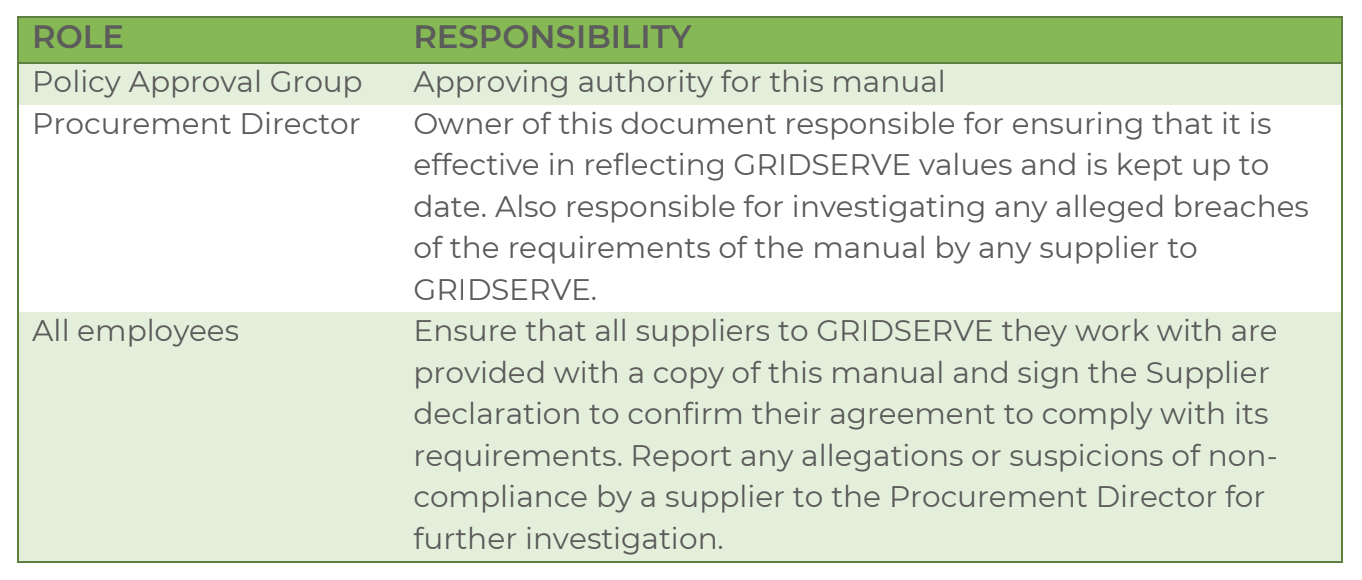
5.0 Definitions
For the purposes of this manual and related policy documents, the following definitions apply:
Conflict-affected and high-risk areas means areas in a state of armed conflict or fragile post-conflict as well as areas witnessing weak or non-existent governance and security, such as failed states, and widespread and systematic violations of international law, including human rights abuses. A non-exhaustive list of these areas maintained by the EU under Regulation (EU) 2017/821 can be accessed at https://www.cahraslist.net/cahras
Policy Approval Group A Group nominated by the Chief Executive Officer to approve certain policies on his behalf in accordance with the company’s Delegations Policy. The Group comprises the Chief Commercial Officer, the Chief Financial Officer, the Risk & Compliance Officer and such other persons as may be nominated by the Chief Executive Officer from time to time.
GRIDSERVE means GRIDSERVE Sustainable Energy Limited and any subsidiary company.